

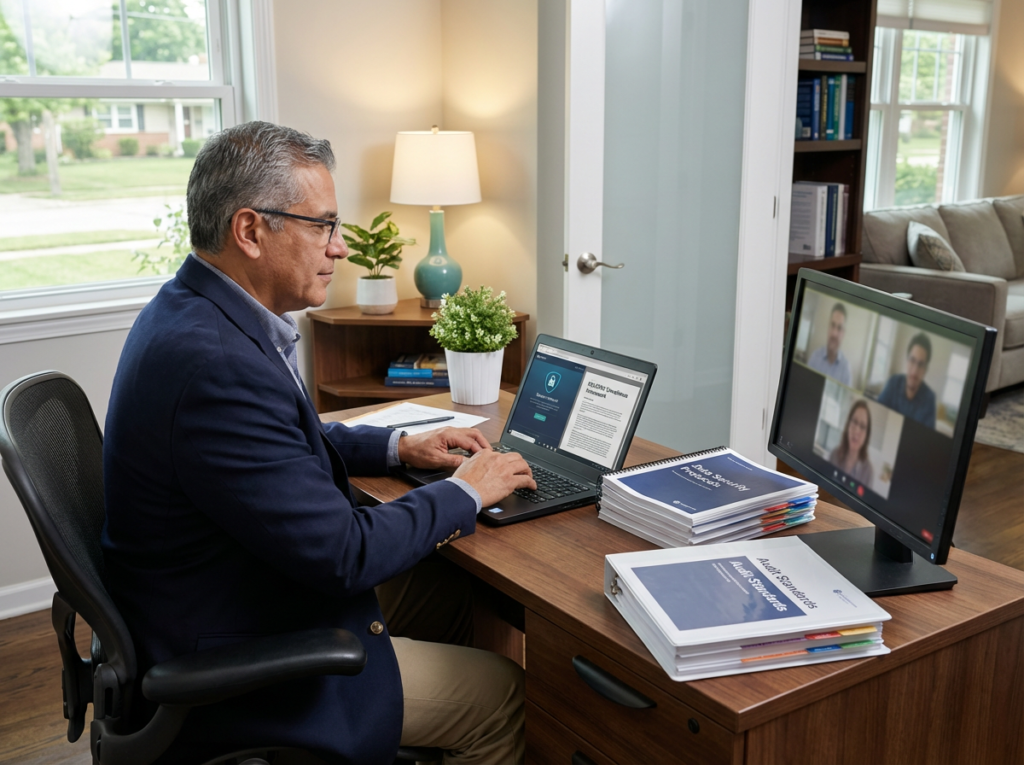
In today’s digital odyssey, where remote work has transformed from a perk to a pillar of modern business operations, the quest to maintain ISO compliance from afar emerges as a vital narrative. As the CEO of Compliancy Group, I’ve steered through these uncharted waters, finding innovative ways to uphold our commitment to ISO standards, regardless of where our work takes us. Here’s how we’ve embraced the challenge, ensuring that distance doesn’t dilute our dedication to excellence and compliance.
The cornerstone of ensuring ISO compliance in a remote work environment is robust digital infrastructure. It’s about creating a virtual office that mirrors the compliance-driven ethos of our physical spaces. From secure cloud storage solutions to encrypted communication channels, we’ve leveraged technology to maintain the integrity and confidentiality of our data, ensuring that our digital workflows meet ISO’s stringent requirements.
For organisations pursuing ISO certifications—whether ISO 9001:2015 (quality management), ISO 45001:2023 (occupational health and safety), ISO 27001:2022 (information security), or ISO 14001:2015 (environmental management)—remote work presents both challenges and opportunities.
The digital infrastructure you establish must support your compliance objectives:
At Compliancy Group, we’ve implemented these systems not just to enable remote work but to strengthen our compliance posture. The organisations we work with that have invested in robust digital infrastructure report stronger compliance outcomes and more efficient certification assessments.
Different ISO standards present different challenges in a remote work environment. Understanding these is critical for maintaining compliance:
ISO 9001:2015 (Quality Management) Remote work requires clear processes for document control, change management, and communication. Quality standards must be maintained regardless of location. This means: – Clear, accessible procedures available to all remote workers – Consistent application of quality standards across distributed teams – Regular communication about quality objectives and performance – Documented evidence of compliance activities
ISO 45001:2023 (Occupational Health and Safety) Remote work changes the hazard landscape but doesn’t eliminate safety responsibilities. You must: – Assess hazards specific to remote work (ergonomics, mental health, isolation) – Ensure remote workers have access to safety information and training – Maintain incident reporting systems that capture remote work incidents – Support worker wellbeing through clear policies and resources – Conduct regular check-ins to identify emerging health and safety concerns
ISO 27001:2022 (Information Security) This is perhaps the most critical standard for remote work. Remote work increases information security risks: – Secure home office environments and device management – Clear policies on data handling and confidentiality – Encrypted communication and file storage – Regular security awareness training for remote workers – Incident reporting procedures for security breaches – Access controls and authentication systems
ISO 14001:2015 (Environmental Management) Remote work can actually support environmental objectives, but you must still manage environmental impacts: – Policies on energy use and waste management in home offices – Monitoring of environmental impacts across distributed operations – Clear communication of environmental objectives to remote workers – Processes for managing environmental incidents
Remote work demands a high degree of self-regulation and awareness among team members. To this end, fostering a culture where every individual understands their role in upholding ISO standards is crucial. Through regular training sessions, virtual workshops, and clear, accessible documentation, we empower our team with the knowledge and tools they need to be proactive guardians of compliance, no matter where they log in from.
Building compliance culture in a remote environment requires intentional effort:
Clear Communication – Make compliance expectations explicit and accessible – Use multiple channels to communicate standards and procedures – Create FAQs and guidance documents specific to remote work – Hold regular virtual meetings to discuss compliance topics – Ensure new remote hires receive comprehensive compliance training
Training and Development – Provide role-specific training on compliance responsibilities – Include remote work scenarios in training programmes – Use virtual workshops and e-learning modules – Ensure training is documented and tracked – Regularly refresh training to address emerging compliance issues
Accessibility of Documentation – Make all compliance documentation easily searchable and accessible – Use plain language that remote workers can understand – Provide quick-reference guides for common compliance questions – Ensure documentation is kept current and version-controlled – Make it easy for remote workers to access the information they need
Recognition and Accountability – Recognise individuals and teams who demonstrate strong compliance practices – Hold regular one-on-ones to discuss compliance responsibilities – Include compliance performance in performance reviews – Create accountability for compliance at all levels – Support people who struggle with compliance rather than punishing them
Psychological Safety – Create an environment where people can raise compliance concerns without fear – Encourage reporting of near-misses and potential issues – Respond constructively to compliance breaches – Use incidents as learning opportunities – Support remote workers who feel isolated or disconnected
Navigating the seas of remote work compliance requires a map and compass, and for us, regular audits and check-ins serve this purpose. By periodically reviewing our remote work processes against ISO standards, we can identify potential discrepancies and adjust our course promptly. These audits, coupled with regular team check-ins, ensure that our commitment to compliance is both measured and managed dynamically.
Effective audit and check-in processes for remote work include:
Internal Audits – Schedule regular audits of remote work compliance – Audit both systems (are processes being followed?) and culture (do people understand why?) – Check documentation, training records, and incident reports – Verify that digital systems are functioning as intended – Assess compliance with specific ISO standard requirements – Document findings and track corrective actions
Management Reviews – Regularly review compliance performance data – Assess effectiveness of remote work policies and procedures – Identify trends in incidents, near-misses, or compliance issues – Discuss emerging risks related to remote work – Make decisions about resource allocation and process improvements – Document decisions and actions taken
Team Check-ins – Hold regular one-on-ones with remote workers – Discuss any compliance challenges they’re facing – Gather feedback on the effectiveness of policies and procedures – Identify support needs (training, resources, equipment) – Recognise compliance efforts and address concerns – Build relationships and maintain connection
Compliance Metrics – Track key compliance metrics (training completion, incident rates, audit findings) – Monitor trends over time – Use data to identify areas needing improvement – Share metrics with teams to maintain awareness – Use metrics to inform decision-making
Certification Readiness – Conduct mock audits before formal certification assessments – Ensure documentation is organised and accessible – Verify that all required records are complete and current – Identify and address gaps before the formal audit – Prepare teams for auditor interviews
In the realm of remote work, collaboration tools are more than just conveniences—they’re lifelines that tether us to our compliance objectives. By utilising platforms that facilitate seamless collaboration, document control, and project management, we ensure that compliance is a collective effort, integrated into the daily workflow of our teams, rather than an afterthought.
The right collaboration tools support compliance by:
Document Control and Management – Centralised storage with version control and audit trails – Clear approval workflows for policy and procedure changes – Easy access to current documentation for all team members – Automatic notification of document updates – Archiving of superseded documents – Integration with your quality management system
Communication and Transparency – Clear channels for discussing compliance issues – Documentation of decisions and discussions – Easy escalation of concerns to management – Regular updates on compliance performance – Celebration of compliance achievements
Project and Process Management – Clear assignment of compliance responsibilities – Tracking of compliance activities and deadlines – Visibility into compliance status across teams – Integration of compliance into project workflows – Automated reminders for compliance tasks
Training and Knowledge Management – Centralised training materials and records – Tracking of training completion – Easy access to guidance and procedures – Knowledge sharing across distributed teams – Documentation of competency assessments
Incident and Issue Management – Easy reporting of incidents and near-misses – Tracking of investigation and corrective actions – Documentation of lessons learned – Trending of incidents to identify patterns – Communication of actions taken
Successful remote work compliance starts with clear, comprehensive policies that address:
Work Environment and Equipment – Standards for home office setup (ergonomics, security, safety) – Equipment provision and management – Internet and connectivity requirements – Support for technical issues – Health and safety responsibilities
Data Security and Confidentiality – Rules for handling sensitive information – Use of personal devices and networks – Backup and storage requirements – Incident reporting procedures – Consequences of breaches
Working Hours and Availability – Expectations for working hours and availability – Time zone considerations for distributed teams – Communication protocols – Flexibility and boundaries – Support for work-life balance
Health, Safety, and Wellbeing – Ergonomic assessments and support – Mental health resources and support – Isolation and connection strategies – Regular check-ins – Access to occupational health services
Compliance Responsibilities – Clear expectations for compliance – Training requirements – Incident reporting procedures – Audit and assessment processes – Support and resources available
When pursuing ISO certifications with a remote workforce, certification assessments present unique challenges:
Documentation Readiness – Ensure all required documentation is organised and accessible – Verify that records are complete and current – Prepare evidence of compliance activities – Organise documentation by ISO requirement – Make it easy for auditors to find what they need
Auditor Access – Plan how auditors will access remote workers for interviews – Arrange video conferencing facilities – Prepare remote workers for auditor interviews – Ensure auditors can access digital systems and documentation – Plan for document review and verification
Team Preparation – Brief teams on what to expect during assessment – Ensure teams understand their compliance responsibilities – Prepare key personnel for auditor questions – Address any outstanding compliance issues – Build confidence in your compliance systems
Mock Audits – Conduct internal audits before formal assessment – Simulate the assessment process – Identify and address gaps – Prepare teams for the real assessment – Build confidence and readiness
Ultimately, maintaining ISO compliance in a remote setting is about more than just adherence to standards—it’s about embracing the spirit of these standards as a guiding principle for operational excellence. It’s a testament to the agility, resilience, and commitment of our team, proving that even as the nature of work evolves, our dedication to quality and compliance remains steadfast.
At Compliancy Group, we’ve learned that organisations that successfully maintain compliance in remote work environments share common characteristics:
For our clients in oil and gas, food safety, construction, and other regulated industries, remote work compliance is increasingly important. Whether you’re implementing ISO 45001:2023, ISO 27001:2022, ISO 9001:2015, or other standards, the principles remain the same: clear expectations, robust systems, strong communication, and genuine commitment to compliance.
We help our clients navigate remote work compliance challenges. We work with you to:
The future of work is increasingly distributed. The organisations that thrive are those that can maintain excellence and compliance regardless of where their people work. At Compliancy Group, we’re here to help you achieve that.