

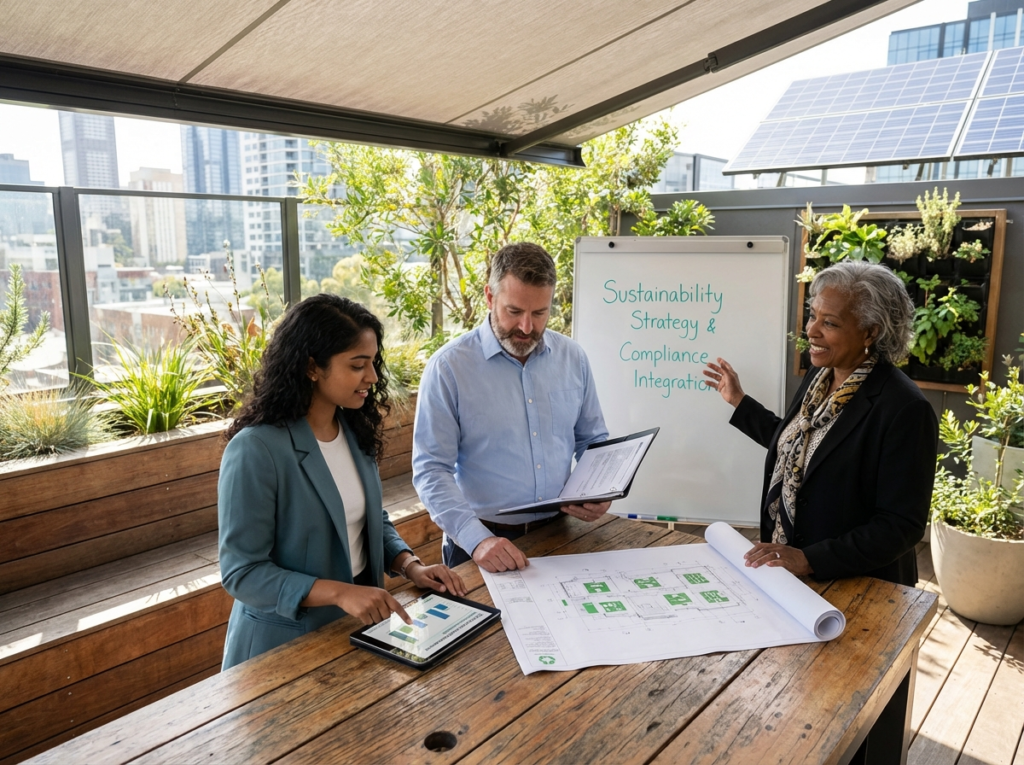
In the grand voyage of modern business, where the destination is a greener, more sustainable future, ISO compliance emerges as both our compass and map. As the CEO of Compliancy Group, I’ve witnessed how intertwining the threads of sustainability with the rigour of ISO standards not only enriches our environmental efforts but also propels the entire vessel of our enterprise towards long-term viability and success. Let’s delve into this journey, exploring how the marriage of sustainability efforts with ISO compliance isn’t just good for the planet—it’s a strategic imperative for businesses aiming to thrive in tomorrow’s world.
The foundation of our sustainability voyage lies in the robust framework provided by various ISO standards. These aren’t just badges of honour; they’re blueprints for building a business that respects and rejuvenates our planet. Whether it’s ISO 14001:2015 guiding our environmental management systems or ISO 50001:2011 enhancing energy efficiency, these standards serve as stepping stones towards minimising our ecological footprint.
At Compliancy Group, we help organisations understand that ISO standards are powerful tools for embedding sustainability into business operations:
ISO 14001:2015 (Environmental Management Systems) This standard provides a framework for organisations to: – Identify and manage environmental aspects and impacts – Set environmental objectives and targets – Implement processes to achieve these objectives – Monitor and measure environmental performance – Continuously improve environmental management – Demonstrate commitment to environmental responsibility
ISO 14001:2015 isn’t just about compliance—it’s about building a systematic approach to environmental stewardship that delivers business benefits alongside environmental benefits.
ISO 50001:2011 (Energy Management Systems) Energy efficiency is a critical component of sustainability. ISO 50001:2011 helps organisations: – Establish energy policies and objectives – Identify energy consumption patterns – Implement energy efficiency improvements – Monitor and measure energy performance – Achieve cost savings through reduced energy consumption – Reduce carbon footprint
For organisations in energy-intensive sectors like oil and gas, food production, and construction, ISO 50001:2011 is a powerful tool for both sustainability and operational efficiency.
ISO 45001:2023 (Occupational Health and Safety) and Sustainability While not explicitly an environmental standard, ISO 45001:2023 supports sustainability by: – Protecting worker health and wellbeing – Reducing incidents and their environmental consequences – Promoting safe work practices that minimise environmental impact – Supporting mental health and psychological safety – Building resilient organisations that can adapt to environmental challenges
Integrated Management Systems The most powerful approach is integrating multiple ISO standards into a unified management system where: – Environmental, quality, safety, and energy objectives are aligned – Common processes support multiple standards – Resources are used efficiently – Continuous improvement benefits all areas – Sustainability is embedded in how work gets done
One might think the benefits of aligning sustainability with ISO compliance are purely environmental. Yet, the impact extends far beyond. It’s about painting a bigger picture where eco-friendly practices drive operational efficiency, innovation, and brand loyalty. At Compliancy Group, embracing these standards has not only reduced waste and energy consumption but has also opened doors to new markets and customers who value environmental stewardship as much as we do.
Operational Efficiency and Cost Savings Sustainability and ISO compliance drive operational improvements: – Reduced energy consumption lowers operating costs – Waste reduction improves efficiency and margins – Optimised processes reduce resource consumption – Better asset management extends equipment life – Preventative maintenance reduces downtime – Data-driven decision-making improves performance
Risk Management and Resilience Environmental and sustainability risks are business risks: – Climate change impacts supply chains and operations – Regulatory changes create compliance risks – Resource scarcity affects availability and costs – Reputational damage from environmental incidents is costly – Organisations with strong environmental management are more resilient – ISO 14001:2015 and ISO 50001:2011 help identify and manage these risks
Market Advantage and Customer Demand Sustainability is increasingly a competitive differentiator: – Customers increasingly prefer sustainable suppliers – Investors favour companies with strong environmental practices – Regulatory bodies reward proactive environmental management – Supply chain partners require environmental compliance – Brand reputation is enhanced by genuine sustainability commitment – New market opportunities emerge for sustainable businesses
Talent Attraction and Retention Employees increasingly value environmental responsibility: – Younger workers prioritise working for sustainable companies – Environmental commitment improves employee engagement – Purpose-driven work attracts and retains talent – Sustainability initiatives improve workplace culture – Employee wellbeing is linked to organisational values – Strong safety and environmental cultures reduce turnover
Innovation and Competitive Advantage Sustainability drives innovation: – Environmental challenges spark creative solutions – Efficiency improvements lead to new products and services – Technology adoption for sustainability creates competitive advantage – Sustainability-focused organisations attract innovative talent – Collaboration on environmental goals builds partnerships – First-mover advantage in sustainable practices
Different ISO standards address sustainability in different ways. Understanding these connections is critical for building truly sustainable organisations:
Quality and Sustainability (ISO 9001:2015) Quality and sustainability are interconnected: – Quality processes reduce waste and rework – Efficient processes consume fewer resources – Customer satisfaction reduces product returns – Long-lasting quality products reduce environmental impact – Continuous improvement drives sustainability improvements – Quality culture supports sustainability culture
Information Security and Sustainability (ISO 27001:2022) Information security supports sustainability: – Secure digital systems reduce paper consumption – Efficient data management reduces storage and energy needs – Cybersecurity protects against disruption to sustainability initiatives – Digital transformation enables remote work and reduced travel – Data analytics support sustainability decision-making – Secure systems enable transparent sustainability reporting
Let’s be real—charting a course towards sustainability isn’t without its squalls and high seas. Integrating environmental goals with compliance requirements demands a shift in mindset, processes, and sometimes, infrastructure. Yet, each challenge faced is an opportunity in disguise. By adopting a holistic approach to compliance, where sustainability is embedded in every action and decision, we’ve turned potential hurdles into milestones of innovation and growth.
Common Challenges and Solutions
Challenge: Upfront Investment Costs – Solution: Frame sustainability as investment, not cost. Calculate return on investment including operational savings, risk reduction, and market benefits. Seek grants and incentives. Phase implementation strategically.
Challenge: Complexity of Multiple Standards – Solution: Integrate standards into unified management systems. Use common processes and documentation. Seek expert guidance. Build internal capability gradually.
Challenge: Changing Organisational Culture – Solution: Start with leadership commitment. Communicate the ‘why’. Engage teams in sustainability initiatives. Celebrate progress. Make sustainability everyone’s responsibility.
Challenge: Supply Chain Sustainability – Solution: Work with suppliers on sustainability goals. Share best practices. Provide support and training. Build partnerships around sustainability. Monitor and measure progress.
Challenge: Measuring and Reporting Progress – Solution: Establish clear metrics aligned with ISO standards. Use data management systems. Regular monitoring and reporting. Transparent communication of progress and challenges.
Challenge: Keeping Up with Regulatory Changes – Solution: Stay informed about regulatory developments. Engage with industry bodies. Build flexibility into systems. Regular review of compliance requirements. Proactive adaptation.
In this quest, technology has been the wind in our sails, enabling us to achieve compliance and sustainability goals with greater precision and efficiency. From utilising renewable energy sources to deploying software that tracks our carbon footprint, technology has been a catalyst in harmonising our ISO compliance efforts with our sustainability ambitions.
Technology Enabling Sustainability
Renewable Energy and Efficiency – Solar, wind, and other renewable energy sources – Smart building management systems – LED lighting and efficient HVAC systems – Energy monitoring and optimisation software – Electric vehicles and sustainable transport – Integration with ISO 50001:2011 energy management
Data Analytics and Monitoring – Real-time monitoring of environmental metrics – Predictive analytics for resource consumption – Carbon footprint tracking and reporting – Waste tracking and optimisation – Supply chain sustainability monitoring – Performance dashboards for decision-making
Digital Systems and Dematerialisation – Cloud-based systems reducing on-site infrastructure – Digital documentation reducing paper consumption – Remote work capabilities reducing travel and commuting – Virtual meetings reducing business travel – E-learning reducing travel for training – Digital reporting and communication
Supply Chain Transparency – Blockchain for supply chain traceability – Digital systems for supplier compliance monitoring – Real-time visibility into supply chain sustainability – Automated reporting and compliance tracking – Collaboration platforms for supplier engagement – Integration with ISO 14001:2015 environmental management
Circular Economy Solutions – Software for tracking product lifecycle – Systems for managing product take-back and recycling – Digital platforms for sharing and reuse – Waste management optimisation – Resource recovery and remanufacturing systems – Life cycle assessment tools
Central to this journey is the cultivation of a culture where sustainability is the norm, not the exception. It’s about leading by example, where every level of leadership demonstrates a commitment to eco-friendly practices. Moreover, engaging the entire team in our sustainability goals has been pivotal. Through education, participation, and recognition, we’ve fostered a collective responsibility towards the planet that transcends job descriptions and departmental boundaries.
Building Sustainability Culture
Leadership Commitment – Visible commitment from senior leadership – Sustainability integrated into strategic planning – Resources allocated to sustainability initiatives – Leaders modelling sustainable behaviours – Accountability for sustainability performance – Integration with business objectives
Communication and Transparency – Clear communication of sustainability vision and goals – Regular updates on progress and challenges – Transparent reporting of environmental performance – Sharing of successes and lessons learned – Open dialogue about sustainability challenges – Engagement with external stakeholders
Employee Engagement and Participation – Involving teams in sustainability initiatives – Creating opportunities for input and ideas – Recognising sustainability contributions – Training and development on sustainability – Making sustainability part of everyone’s role – Building pride in sustainability achievements
Supplier and Partner Engagement – Working with suppliers on sustainability goals – Sharing best practices and support – Collaborative problem-solving – Recognition of supplier sustainability efforts – Integration of sustainability into procurement – Building partnerships around shared values
Community and Stakeholder Engagement – Transparency with customers and investors – Engagement with local communities – Support for environmental initiatives – Contribution to industry sustainability efforts – Participation in sustainability standards development – Building reputation as responsible business
Measurement and Accountability – Clear metrics aligned with ISO standards – Regular monitoring and reporting – Accountability at all levels – Linking sustainability performance to rewards – Continuous improvement based on data – Public commitment and reporting
At Compliancy Group, we work extensively in sectors with significant environmental impacts. We help organisations in these sectors achieve sustainability and compliance:
Oil and Gas Industry – Compliance with environmental regulations – Minimising emissions and environmental impact – Safe and sustainable operations – GIRS (Gas Industry Registration Scheme) compliance – Environmental risk management – Sustainable development in energy sector
Food Safety and Production – Sustainable sourcing and supply chains – Waste reduction and management – Water efficiency and protection – BRCGS and FSSC 22000 compliance with sustainability – Packaging and environmental impact – Traceability and transparency
Construction and Infrastructure – Sustainable building practices – Waste management and recycling – Environmental impact assessment – Constructionline compliance with sustainability – Worker safety and environmental responsibility – Long-term environmental stewardship
As we sail towards a greener future, the synergy between sustainability and ISO compliance stands as a testament to our commitment to the planet and to sustainable business practices. This journey is a continual process of learning, adapting, and innovating, with each step forward bringing us closer to a world where business and environmental wellbeing are inextricably linked.
The Path Forward
For organisations embarking on or advancing their sustainability journey, we recommend:
At Compliancy Group, we’re committed to supporting organisations on their sustainability journey:
To those who share this vision, let’s embrace the challenge and the opportunity to lead the charge towards a sustainable future. It’s a journey worth embarking on, where the rewards extend far beyond the bottom line, to a legacy of positive impact on the world we inhabit.
Sustainability and ISO compliance are not competing priorities—they’re complementary. Organisations that successfully integrate them gain competitive advantage, build resilience, attract talent, and create positive environmental impact. They’re the organisations that will thrive in tomorrow’s world.
At Compliancy Group, we’re here to help you on this journey. Whether you’re just beginning your sustainability journey, pursuing ISO 14001:2015 or ISO 50001:2011 certification, or seeking to deepen your sustainability commitment, we have the expertise and experience to support you.
Here’s to steering our businesses towards a greener, more sustainable horizon, guided by the principles of ISO compliance and fuelled by our collective ambition for a better tomorrow. Together, we can build organisations where business success and environmental responsibility go hand in hand.